
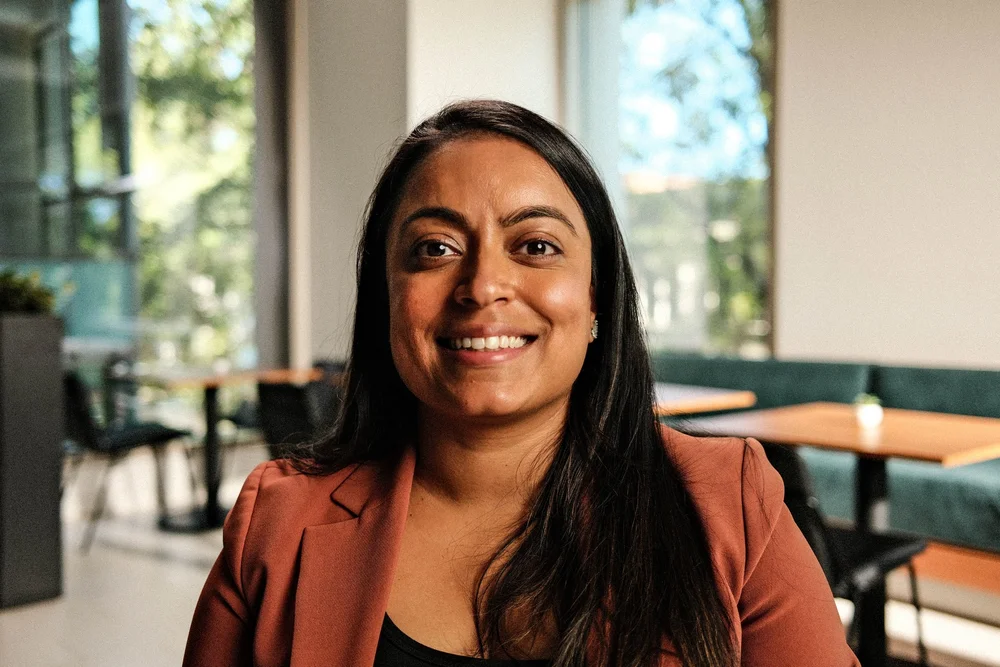
 ▶ Get to know KimKim PatelVP of Startup Banking, JPMorgan Chase
MULTIPLY 2026 SPEAKER
Kim Patel
VP of Startup Banking, JPMorgan Chase
THE TALKThe Translation Tax
Session 2 · TRANSFORMATION: The Multiplier Effect · Saturday, November 21 at 2:30pmGET TO KNOW KIM
ABOUT KIM
At a glance.
- VP of Startup Banking at JPMorgan Chase
- Forbes 30 Under 30 honoree
- Harvard MBA as an Arthur Rock Fellow
- Founder of FLK Advisors, has coached 200+ startup founders
- Has spoken at SXSW, Harvard, Fordham, and Startup Boston Week
THE STORY
Naming the Cost: Kim Patel on Fitting In, Burning Out, and the Translation Tax
"We all pay hidden costs to fit in, and what we lose is the very thing that makes us valuable."
That's the idea Kim Patel spent five years working out, and the one she's bringing to TEDxUnityPark 2026.
Kim spends her days with first-time founders. She's VP of Startup Banking at JPMorgan Chase, the founder of FLK Advisors, a Forbes 30 Under 30 honoree, and a Harvard Business School MBA as an Arthur Rock Fellow, and she has worked directly with more than 200 startup founders. At this year's TEDxUnityPark, her talk "The Translation Tax" asks what it really costs to keep adjusting yourself to be taken seriously, and who ends up paying it.
"I call it the translation tax: the cognitive, emotional, and economic cost of constantly adjusting how you think, speak, and show up to be recognized as credible within a system."
Kim grew up in Jersey City, a first-generation professional and the daughter of Indian immigrants who never finished high school. The idea started at home, long before she had a name for it.
"I watched my father spend his entire life adjusting how he showed up to be taken seriously in systems that were not built for him," as she puts it.
She paid for NYU, which she has some opinions about, by working as a part-time investment banker while she was still in school. "It's very unnecessary, the amount of tuition that they charge," she said during TEDxUnityPark Media Day.
From there she took that business background into journalism and news, and that work led her to founders with good ideas who kept hitting the same wall. She found herself "working with female founders who were having a tough time raising capital because they couldn't translate their ideas to finance folks because it's a different language."
Harvard Business School came with the same cost in a different form.
"This talk stems from my own personal experience of suffering from severe and chronic burnout at the age of 30 graduating from Harvard Business School,"* she said at Media Day. *"Which is ironic because one would think, you know, I made it, but actually I was in the bottom of the barrel."
"It took five years to understand why," as she puts it. "That is not a motivational arc. It is a research question."
Kim decided to go answer it.
The answer took her into tutorial work at Oxford on class mobility and entrepreneurship, and into peer-reviewed research in psychology and neuroscience. What she found is that the cost is measurable. The research she leans on shows it "depletes working memory, elevates cortisol, and suppresses original thinking."
It's a bit like the foreign transaction fee on a debit card. Small every time, and you only see what it added up to when you look at the statement.
"The problem is not a shortage of intelligence or capability. It is that institutions only recognize intelligence when it arrives fluent in their codes."
She's careful not to make translation the villain. "If you just think about those like everyday moments, that's translation," she says. "And translation isn't necessarily a bad thing. It does, however, at times create a lot of costs that don't actually outweigh the benefit."
That's the part we love about Kim. She has the résumé for a polished keynote about success, and she'd rather show you the receipt. She's spoken at SXSW, Harvard, Fordham, and Startup Boston Week, and she's plain about what she's offering: "The value I bring to this community is not inspiration," as she puts it. "It is a framework, grounded in research, that names something people have been carrying for years and calling their own failure."
TEDxUnityPark's 2026 theme is Multiply, which for us means growing your reach through your work and your relationships. Kim's talk is the honest math underneath that. Every room that makes someone translate is charging them, and it adds up across a career, a company, a whole city. Lower the tax and there is more left over to multiply.
This was Kim's first time in Greenville, and she noticed the details. "There were a lot of folks out this morning having breakfast on the patio, and so this neighborhood vibe in the city is, like, really what I appreciate," she said.
"When we stop taxing difference, we unlock what people can actually contribute and what communities can build."
What many don't know about Kim is that she's very funny about where she comes from. She introduced herself on camera as being "from the great state of New Jersey. Some people call it the armpit of America, but that's a separate issue."
She still thinks like a historian. "I tend to get a kick out of just observing," she said. "I think it's why I studied history in college." From her home base in Chicago, she works with founders across 13 states in the Midwest, from Fargo to Cincinnati.
This one is for anyone who has ever rewritten a sentence in their head three times before saying it out loud in a meeting. Kim gives that feeling a name, and a price. We can't wait for you to hear this one.
"The next time it happens, they can leave with a different set of reflections."
NOVEMBER 21
See Kim live.
Catch Kim in Session 2, TRANSFORMATION: The Multiplier Effect, at 2:30pm. Or get the All-Day Pass for all three sessions and Kickoff Night.
Get ticketsAll speakers